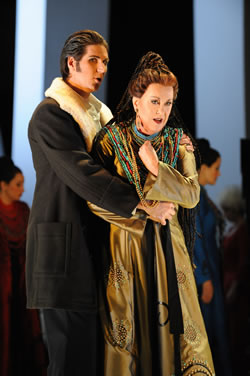
Left - Luke Gabbedy and Yvonne Kenny in Dido and Aeneas. Cover - Taryn Fiebig, Henry Choo and Shane Lowrencev in Acis and Galatea. Photos - Branco Gaica
Opera Australia’s Baroque Masterpieces presents a beautifully complementary double-bill – Georg Frideric Handel’s Acis and Galatea with Henry Purcell’s Dido and Aeneas, tragic Baroque musical scores expressing the heartbreak of lost love.
Director Patrick Nolan draws and investigates the parallel reflections of public and private between the two operas. In Acis and Galatea the lovers struggle to find privacy; in Dido and Aeneas, Queen Dido is constrained by her public responsibility and her private desire. The psychological thread that Nolan sews is an interesting one, but one that requires a light touch and subtlety.
Nolan’s Acis and Galatea is set in a white-clad contemporary world complete with an iPod-plugged stripper, cocaine-sniffing paparazzo friend to Acis, and a sexually-charged groping chorus. The world is one not too far removed from our own. Perhaps Nolan’s interpretation was intended to make the Baroque character of the music more accessible, but the music and stage elements only seemed to clash. In particular, the sexually fumbling chorus detracted from the delicate beauty of the music.
With the ever-present chorus, Nolan created a strong sense of the lovers desperately seeking privacy. The idea, however, was slapped on thick, with oversized plastic eye masks worn by the chorus and then discarded across the stage. As Polyphemus (Shane Lowrencev) trilled, the chorus bobbed their all-seeing eyes uncontrollably. The playfulness detracted from the music and its poignant story.
Thankfully, the musical performance captured the essence of the ill-fated love in spite of the clashing stage elements. The
distinctive Baroque character was brought to life by the Orchestra of the Antipodes under Antony Walker – the period instruments immediately evoking a different time and place.
As Acis and Galatea, Henry Choo and Taryn Fiebig performed commendably. Fiebig has an exquisite legato (however, often sacrificing diction for line) and Choo a lovely light tenor. But the passion and burning desire of the love which Acis and Galatea feel was not realised, replaced with a stiff stylised gestural quality devoid of emotional connection. Kanen Breen was the highlight as Damon, the cocaine-sniffing paparazzo – performing with a slimy charm almost as greasy as his slicked-back shoulder-length hair. Breen has a wonderful easy presence and energy on stage, and relished Nolan’s contemporary realism.
Nolan’s second-act Dido and Aeneas provided a welcome fantasy world much more complementary to Purcell’s music. The visual design was striking in its bold black, red, and white simplicity, placing the focus firmly on Purcell’s famous music and the soloists in their regal gowns.
Yvonne Kenny was charming as Dido, her statuesque frame a commanding presence on stage, allowing her to perform with a lovely sincere simplicity. Here, the passion of her love for Aeneas (Luke Gabbedy) was held-back intentionally, creating a beautiful tension between the two lovers and their desire.
Once again, however, the highlight of the performance was Kanen Breen’s sorcerer. Breen was wonderfully wicked as the writhing androgynous sorcerer, his falsetto off-setting his tenor deliciously.
Sitting in judgement of Dido, and plotting with the sorcerer, this chorus were much more effective than the sexually-charged contemporary crew. Simplicity of sentiment and staging seemed to be the key to realising the music and its story. The final chorus was presented with a stillness that revealed the masterpiece.
Opera Australia presents
Baroque Masterpieces
Henry Purcell & George Frideric Handel
Venue: Opera Theatre, Sydney Opera House
Dates: June 27; July, 1, 3, 9, 14, 18 @ 7.30pm
Matinee: July 11 @ 1pm
Bookings: 02 9318 8200 | 02 9250 7777 or opera-australia.org.au
Sydney Reviews
Baroque Masterpieces | Opera Australia
- Details
- Olympia Bowman-Derrick
Most read Sydney reviews
The Lark | Hey Dowling
Noni Hazlehurst brings Rose and The Lark to colourful and compelling life in this one-woman show.
Uked! | Bondi Theatre Company
Uked! is a sing along, string along, immersive jukebox musical, that's more folksy balladeering than an all out, all that jazz razzmatazz.
Doubt | Sydney Theatre Company
Contradiction, conundrum, conflict, racism, misogyny and homophobia run through this play like a main circuit cable snaking through a moral minefield of explosive allegation.
The Can Principle | Jonny Pasvolsky
Following the unedifying edict that "there's a sucker born every minute", the show skewers the modern self-improvement economy in a piss-take parody of today's 'gurus' and snake-oil salesmen.
Heartbreak Hotel | EBKM
Heartbreak Hotel invites its audience into an intimate portrait of the universal and isolating experience of heartbreak.
This rollicking musical take on Jane Austen’s beloved novel is a side-splitting crowd pleaser.
Heartbreak Hotel invites its audience into an intimate portrait of the universal and isolating experience of heartbreak.